Are we potentially over-estimating the power of social media and underestimating search in driving online shopping? The answer is yes according to the latest Forrester Research report, which found that less than one percent of online purchases were influenced by social networks while organic and paid search were responsible for driving 39 percent of new customer sales.
We've spent the past two weeks in my internet and interactive marketing class talking about the importance of SEO and paid search, so while this really shouldn't come as a surprise to me, it does. I talked about the potential power of electronic word-of-mouth in my previous post regarding Myspace, but what I failed to consider was the fact that in some cases, consumers know what they want to purchase when they go online. So rather than turning to their social networks for recommendations or ideas, they turn to search. Forrester calls these individuals "spear fishers."
Utilizing SEO and/or paid search to reach consumers and drive sales online seems like such a simple, logical idea, but it certainly isn't the first thing that pops into my mind. And I imagine I'm not the only one. As marketers, advertisers and PR professionals, we can't let the flashiness of social media distract us from some of the tried and true tools we have at our disposal. Granted, each situation isn't the same, and we have to choose those tools that fit our strategy, but we really have to remember to explore all of our options--not just those with the most buzz. As Forrester's report goes to show, sometimes the flashy tool isn't the most effective one.
Tuesday, September 25, 2012
Monday, September 24, 2012
The New Myspace Makes A Great First Impression
Ok. I'll admit it. I'm more than a little intrigued by the new Myspace teaser issued this week.
Even more than that, however, I can't wait to see what the company has planned for marketing the re-launch of the site over the next few weeks and months. The teaser video they created has set the bar high. I mean, the redesigned site actually looks, well ... cool. And by limiting the number of invitations that are being extended, they've managed to reach the early adopter in me who's shouting "Must. Try. New. Myspace. FIRST!"
News of the announcement is attracting a lot of positive feedback over Twitter as well as in the comments section of websites like Mashable, so they're off to a great start generating buzz. It's exactly what the brand needed to do if it's going to regain the prominence it once had. In my opinion, word-of-mouth is the best thing Myspace has going for it at the moment, especially when you consider this study that observes "in [electronic word-of-mouth] 1 person can affect the behavior of 8 other people." I'm interested to see how they build on this brief momentum; I'm especially looking forward to seeing to how they use Twitter and Facebook in their overall campaign strategy. That is, if they do at all.
But until we see more, consider this: we're using "cool" and "Myspace" in the same sentence. Who would have thought we'd be saying that about the brand in 2012?
Saturday, September 15, 2012
My SEO Experiment with the iPhone 5
In case you missed it (and I'm sure you didn't), this week’s
biggest tech news was undoubtedly Apple’s announcement of the iPhone 5, and with Week 2 of MKT 595 focused on SEO, I decided to conduct my own SEO
experiment to answer the question—what do search results look like for the term
“iPhone 5?”
Using search.yahoo.com
and google.com to conduct my search, the top organic search results in both instances appeared as follows:
As you'll notice, CNET is #2 on Yahoo! and #1 on Google (following the News Results) with Apple.com nowhere insight other than paid search. In fact, Apple.com does not appear on Page 1 organically until below the scroll. And while I
certainly don’t know all of the ins and outs of why Apple.com is so low while
CNET is so high, I do have two ideas based on this week’s
readings and materials.
For
starters, the file name for CNET’s webpage is cnet.com/iphone-5; this is in
stark contrast to apple.com’s URL—apple.com/iPhone. And entering the
following URLs—apple.com/iPhone5, apple.com/iPhone-5 and apple.com/iPhone_5—all take users to a “Page Not Found” page instead of being redirected to its iPhone page. In my opinion, the lack of the redirects is a huge missed opportunity by Apple.
The second factor
that may be contributing to the search results can be found “under the hood” in the
coding of each site. While the title and description of apple.com/iphone and
cnet.com/iphone-5 both include the word “iPhone 5,” Apple’s website shows no
sign of keywords. Meanwhile, CNET’s code appears as follows: <meta name="keywords" content="Apple iPhone 5, Apple iPhone 5 review,
Apple iPhone 5 reviews, Smartphones reviews, Smartphones"/>. In fact, the word itself (iPhone 5) is
used more than 50 times on the page containing CNET’s review of the device—with plenty of links to other CNET content—and only 20
times on Apple’s website. Given CNET’s prominence within the technology
community (as evidenced by the number of comments and social media shares for
their iPhone 5 review page) and the number of times iPhone 5 is used, it’s no
doubt that it ranks so highly.
Now, I'm sure there are other factors impacting these search results, and I’m not suggesting that Apple—or its marketing
agencies—don’t have a firm handle on their digital presence. Apple's brand is so strong that it doesn't need to be the top result on the page to sell the iPhone 5. As we know, pre-orders sold out in an hour. Instead, this search test shows the importance of SEO during a product launch. If you're making headlines as a new company or a company who doesn't have Apple's brand recognition, it's important to make sure you have SEO tactics in place to make sure your website ranks towards the top of the page in order to drive traffic to your website.
Sunday, September 9, 2012
Starbucks and LivingSocial: A Winning Combination
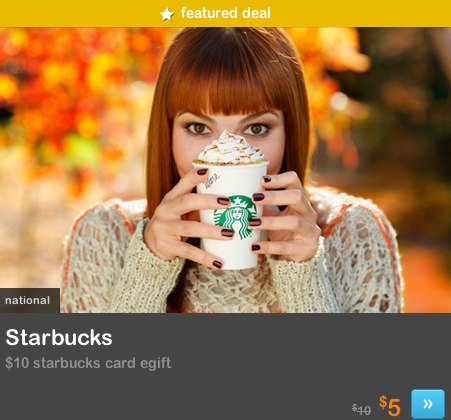
Though deals such as a half-off gift card are nothing new, Starbucks's use of LivingSocial is a great illustration of why the brand continues to be a leader in social media as well as the larger digital landscape. By leveraging LivingSocial (as opposed to Groupon) for this marketing deal, Starbucks masterfully executed the first two stages of John Caples' seven stage process. Not only did the deal grab and hold customers' attention, but there was a ripple effect as news of the discount spread through users' social networks. The brand was also able to easily work through the remaining five stages in Caples's process by setting the price point to create desire, making the deal believable and easy to purchase by using LivingSocial, and of course, creating a sense of urgency by making it available for a limited time.
Starbucks certainly didn't need to offer the deal to get people in its doors, but by doing so, it showed why it's a digital leader. It presented its customers with a value proposition too good to ignore and made it easily shareable by choosing the right partner in LivingSocial. As of this post, the Starbucks Facebook page had received a combined 17,890 likes and 763 comments on its September 4th and 5th posts regarding the offer as well as 3,698 shares. Of course, these numbers don't take into account customers who posted content to their Facebook pages ... or tweets ... or other channels, so I'm sure the final numbers are staggering.
Big, established brands would be wise to follow Starbucks lead (the effectiveness of Groupon and LivingSocial for small businesses is up for debate). As this case study goes to show, even something as basic as a coupon can travel a long way in the digital world.
Subscribe to:
Comments (Atom)